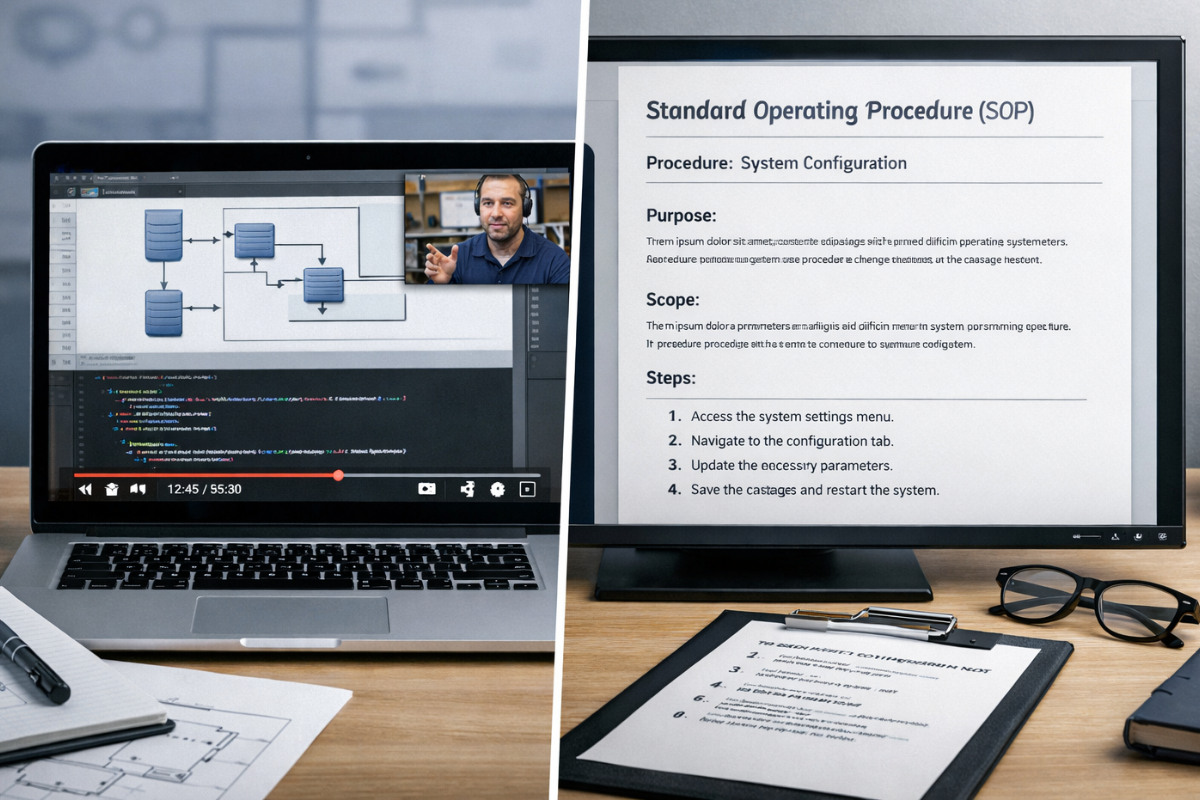

Engineering teams record everything. Architecture deep dives. Incident retrospectives. Platform onboarding sessions. Design reviews with whiteboards filled edge to edge. Yet months later, someone new joins the team and asks the same question that was answered clearly in a recorded walkthrough. The knowledge exists, but it is trapped in video format. It is not structured, searchable, or governed. That gap between recorded insight and operational clarity is where many organizations stall in their documentation maturity.
Walkthrough videos are rich. They contain intent, context, and reasoning. They show how senior engineers think about systems. But without formalization, they remain informal artifacts. Converting those recordings into structured standard operating procedures creates repeatability. It reduces onboarding time. It supports audits. It stabilizes process execution in complex systems where ambiguity is expensive.
Summary
- Recorded engineering walkthroughs contain undocumented institutional knowledge.
- Transcription converts narrative explanations into structured, governed content.
- Formal SOPs improve compliance, onboarding, and operational consistency.
- A defined workflow turns raw video into version-controlled documentation.
From Informal Narratives to Structured Process Assets
Engineering walkthrough videos usually start as knowledge sharing. A senior architect explains deployment topology. A DevOps lead demonstrates rollback procedures. A security engineer reviews access boundaries. These sessions feel conversational, yet they often outline exact procedural steps. The problem is not the absence of knowledge. The problem is the absence of structure.
The first technical move is to convert the video to text so the spoken explanation becomes searchable language. Using a service that can convert video to text transforms a static recording into raw documentation material. Once the narrative is transcribed, engineering teams can identify step sequences, decision criteria, and risk considerations that should be codified into a formal SOP.
Raw transcripts alone are not enough. They must be interpreted, refined, and reorganized. Engineers should extract operational steps, validation checkpoints, and escalation triggers. These elements become the backbone of procedural documentation. Instead of relying on memory or replaying a video, teams gain a structured document aligned with process governance.
Documentation Maturity and Governance Alignment
Organizations pursuing structured engineering governance already recognize the importance of disciplined documentation. For teams adopting practices aligned with model-based systems engineering, clarity and traceability are not optional. They are foundational. A walkthrough video can illustrate system behavior. An SOP defines how that behavior is executed and controlled.
Formal SOPs support repeatability. They define preconditions, actions, expected outcomes, and exception paths. They connect to configuration baselines and change management processes. This is especially important in regulated industries where operational consistency is audited. Informal explanations do not satisfy auditors. Structured procedures do.
The National Institute of Standards and Technology guides documentation and process controls through frameworks such as NIST. These frameworks emphasize traceability, accountability, and repeatable controls. Turning engineering walkthroughs into SOPs directly supports those principles.
A Practical Workflow for Converting Videos Into SOPs
Moving from recording to formal documentation requires a defined workflow. Without structure, teams risk creating inconsistent artifacts. A standardized process ensures quality and consistency across departments.
1. Capture the walkthrough with clear audio and visual references.
2. Transcribe the video to obtain a complete textual record.
3. Identify operational steps, prerequisites, and control points.
4. Reorganize content into a structured SOP template.
5. Review with subject matter experts for accuracy.
6. Version control the finalized document within the knowledge base.
Each stage builds on the previous one. Skipping transcription leads to missed details. Skipping review risks procedural errors. Skipping version control invites drift between practice and documentation.
Refining Spoken Knowledge Into Documented Authority
Spoken explanations often contain digressions, side notes, and assumptions about shared knowledge. Formal documentation cannot rely on assumptions. It must state prerequisites explicitly. It must define system boundaries. It must articulate fallback procedures in precise terms.
Once the transcript is generated, teams can transform refined audio commentary directly into structured documentation. For example, after validating key technical discussions, engineers often convert audio to Word so the content becomes an editable draft that can be reviewed, annotated, and aligned with internal standards. These Word-formatted documents can then be standardized into corporate SOP templates with headers, revision history, approval metadata, and formal version control.
At this stage, documentation shifts from narrative to authority. The SOP becomes the reference for operational execution. Engineers consult it during maintenance windows. Security teams reference it during audits. New hires use it during onboarding. The original video remains valuable for context, yet the SOP becomes the operational anchor.
Connecting SOP Creation to Secure System Practices
Engineering walkthroughs frequently include discussions about access control, privilege boundaries, and secure deployment. Converting those discussions into formal procedures strengthens enforcement. Teams that follow guidance similar to zero-trust architecture in cloud environments understand that procedural clarity reduces the attack surface.
An SOP can specify role-based access validation before deployment. It can define required logging configurations. It can mandate post-deployment verification steps. These structured instructions reduce the risk of misconfiguration that often arises from informal communication.
Security posture improves when processes are documented and versioned. Informal walkthroughs might highlight risks. Formal SOPs institutionalize mitigation steps. That transition is a major step toward operational resilience.
Transforming Knowledge Into an Engineering Asset
Recorded walkthroughs are often archived without classification. Over time, they become difficult to locate. Titles are vague. Metadata is inconsistent. Teams waste time searching through long recordings for specific instructions. A transcription-based workflow changes that dynamic.
Structured SOPs can be tagged by system, environment, and function. They can be indexed within internal search platforms. They can link to configuration repositories and change management tickets. Documentation becomes part of the engineering asset inventory rather than a passive archive.
This approach also supports knowledge retention. Senior engineers eventually transition to roles or leave organizations. Their reasoning patterns, captured in walkthrough videos, can be codified into SOPs that preserve institutional memory. Instead of losing tacit knowledge, organizations formalize it.
Comparing Video Archives and Formal SOPs
| Attribute | Video Archive | Formal SOP |
|---|---|---|
| Searchability | Limited without a transcript | Fully text searchable |
| Governance | Informal | Version-controlled and approved |
| Audit Readiness | Weak documentation trail | Traceable procedural record |
| Onboarding Value | Context-rich but time-consuming | Clear step-by-step guidance |
Key Benefits of Formalizing Engineering Walkthroughs
Teams that adopt this approach typically observe several improvements across operations and compliance domains.
- Reduced onboarding time due to clear procedural references.
- Improved audit outcomes with documented execution steps.
- Lower operational variance across teams.
- Stronger alignment between architecture intent and execution practice.
Each benefit compounds over time. Clear SOPs reduce confusion during incidents. They standardize recovery steps. They define communication channels. Instead of relying on ad hoc memory during high-pressure situations, engineers can execute predefined procedures with confidence.
Embedding SOP Creation Into Engineering Culture
Process transformation requires cultural reinforcement. Recording walkthroughs should not be seen as the final step. Instead, teams should treat recordings as raw material for structured documentation. Engineering leads can assign documentation stewards responsible for transcript review and SOP drafting.
Peer review strengthens accuracy. Version control ensures updates reflect system evolution. Regular review cycles keep procedures aligned with architecture changes. Documentation becomes a living component of the engineering lifecycle rather than a static artifact created once and forgotten.
As systems scale, the cost of undocumented knowledge grows. Complexity multiplies. Dependencies expand. Formal SOPs act as stabilizers. They reduce ambiguity and support disciplined execution across distributed teams.
Where Structured Documentation Meets Long-Term Resilience
Turning engineering walkthrough videos into formal SOPs is not a cosmetic improvement. It is a structural one. It shifts knowledge from transient conversations to governed artifacts. It aligns operational execution with documented authority. It supports compliance, security, and scalability without sacrificing context.
Engineering organizations that treat transcription as a bridge between narrative insight and procedural clarity build stronger foundations. They create documentation that reflects real system behavior rather than theoretical diagrams. They preserve expertise. They reduce operational drift. Over time, this practice transforms recorded sessions from passive archives into active components of system reliability.
In complex engineering environments, clarity is a force multiplier. Structured SOPs derived from real walkthroughs ensure that clarity persists long after the recording ends.